
Why Are Safety Glasses Non-Negotiable on a Jobsite?
Recently, Kevin Rice, our Chief Visionary Officer, was out on a project site and found himself in a familiar debate with a superintendent. The pushback sounded like this: “It’s just safety glasses.” But Kevin, with his usual energy and passion, made a powerful point. Not wearing safety glasses is never about comfort or preference. It is a symptom of a deeper problem.
Short answer: Require safety glasses on every project, every day, with no exceptions. If someone can’t or won’t wear them, there’s an underlying problem (attitude, memory, training or culture), and they aren’t ready to be on the project yet. How people handle small things is how they handle big things, so safety glasses are the simplest litmus test you have.
I often hear excuses like “It’s not that big of a deal,” “They’re just workers,” or “That’s their responsibility, not mine.” Sometimes it is framed as, “Jason, you don’t understand what it’s like in our region.” I do understand. What I also understand is that these are simply weak excuses for leaders who are unwilling to do their jobs.
There is not a single project anywhere in the United States where full safety glasses should not be required. This is not about whether eyes are at risk during a specific task. It is about setting and enforcing core values. Safety glasses are to a construction site what core values are to a company: the baseline that identifies who fits and who does not.
What Does It Mean When Someone Won’t Wear Safety Glasses?
If someone cannot or will not wear their safety glasses, there is always an underlying problem. It might be an attitude problem, which has no place on a job site. It might be a memory problem, which makes construction a dangerous environment for them. It might be a training problem, which can and should be fixed. Or it might be a cultural or behavioral issue that needs to be addressed before they can safely work. Whatever the cause, the outcome is the same. If you cannot wear your safety glasses, you are not ready to be on a construction project.
I grew up watching carpenters who wore heavy tool bags, understood complex plans in their heads, and executed their craft with skill. They wore their harnesses every day, had their lanyards inspected, wore full PPE, and often worked in extreme conditions. These were superhuman people doing extraordinary things. Against that backdrop, hearing complaints about something as simple as wearing safety glasses feels ridiculous.
How Do You Answer the Common Objections?
And let’s debunk the common objections. “I can’t see through my glasses.” Then get a pair that fits, keep them clean, or get prescription safety glasses or a pair that fits over regular glasses. If they fog, use anti-fog wipes or anti-fog lenses. These aren’t unsolvable problems. When someone argues about safety glasses, it is not about logic, it is about emotion. They simply do not want to wear them, and they try to justify it after the fact.
Why Are Safety Glasses a Litmus Test?
Think about what a powerful litmus test safety glasses provide. If a worker refuses to wear them, in thirty minutes you will likely find them without fall protection, standing on top of a ladder, or exposed at a leading edge without guardrails. The same mindset that refuses basic eye protection will inevitably lead to bigger and more dangerous risks. Safety glasses are not just about protecting eyes. They are a visible, measurable indicator of whether a worker has the attitude, training, and commitment required to stay safe on site.
I once came across a Hensel Phelps quote that I love so much I made it into a decal for my truck. It said, “There is no job or duty so urgent and important that it cannot be done the safe way.” That principle is timeless. Leaders must hold the line. Allowing someone to work without safety glasses signals that safety is negotiable, and once you compromise in one area, the entire culture erodes.
How Do You Enforce It Without Giving Up on People?
This is not about discarding people. If the issue is skill, we train. If it is attitude, we give them the chance to adjust. But until they are ready, they are not safe to work on the project. Leaders cannot afford to spend endless time cajoling and persuading when hundreds of people need supervision. The standard must be clear and enforced.
The truth is simple. How people do small things is how they do big things. If someone will not wear their safety glasses, they will not be safe in anything else. Make safety glasses mandatory. Enforce it without exception. And recognize that something so simple is the most powerful tool you have to protect lives and elevate the culture of safety in construction.
If your project needs superintendent coaching, project support, or leadership development, Elevate Construction can help your field teams stabilize, schedule, and flow.
On we go.
Key Takeaway
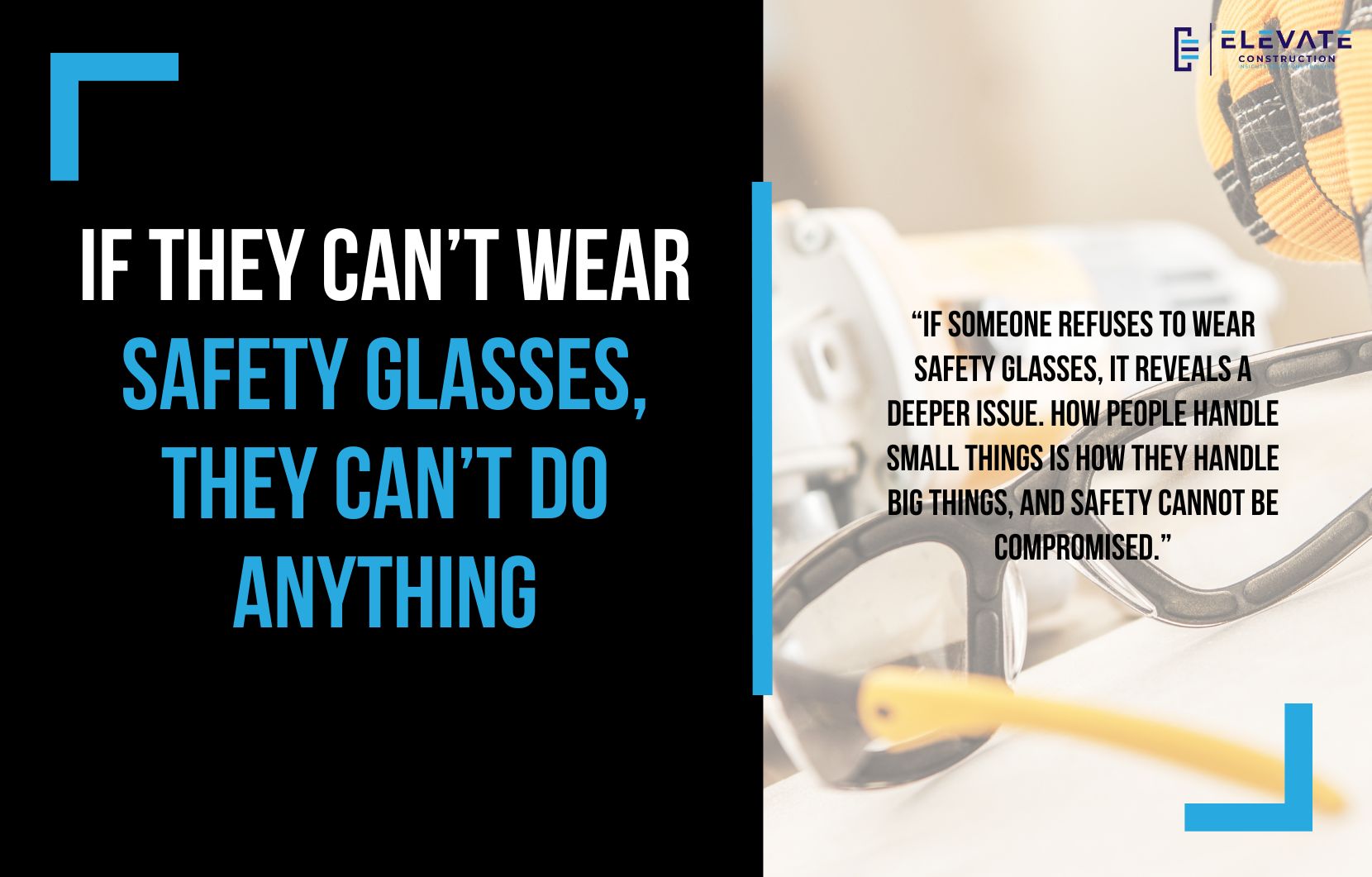
If someone refuses to wear safety glasses, it reveals a deeper issue. How people handle small things is how they handle big things, and safety cannot be compromised.
Frequently Asked Questions
Are safety glasses required on every construction site?
OSHA requires eye and face protection whenever workers are exposed to eye hazards (29 CFR 1926.102). On our projects the standard is simpler: everyone wears safety glasses all the time, so nobody has to decide task by task.
What should you do if a worker refuses to wear safety glasses?
Stop the work and find the reason: attitude, memory, training or culture. Fix training problems with training, give attitude problems a clear chance to adjust, and don’t let the person work until they meet the standard.
What if safety glasses fog up or someone wears prescription glasses?
Use anti-fog wipes or anti-fog lenses, and get prescription safety glasses or a pair that fits over regular glasses. Fogging and fit are solvable problems, not reasons to go without.
If you want to learn more we have:
-Takt Virtual Training: (Takt Virtual Training)
-Check out our YouTube channel for more info: (Elevate Construction on YouTube)
-Listen to the Elevate Construction podcast: (Elevate Construction Podcast)
-Check out our training programs and certifications: (Training Programs and Certifications)
-The Takt Book: (The Takt Book on Amazon)
Discover Jason’s Expertise:
Meet Jason Schroeder, the driving force behind Elevate Construction. As the company’s Founder and COO, he’s dedicated to taking construction to new heights. With a wealth of industry experience, he’s crafted the Field Engineer Boot Camp and Superintendent Boot Camp – intensive training programs engineered to cultivate top-tier leaders capable of steering their teams towards success. Jason’s vision? To expand his training initiatives across the nation, empowering construction firms to soar to unprecedented levels of excellence.